INTERCHANGE SUPPORT MATERIAL
ADAPTATIONS FOR CAPITALIST RUINS @ NAC
Adaptations for Capitalist Ruins was commissioned by The National Arts Centre for the Kipnes Lantern, a hexagonal glass building, four of whose faces are composed of LED screens. Viewers never see the entire video surface; their perspective changes with their position on the street. This constraint became both a consideration and a tool for storytelling.
This work uses extremophiles (microbes able to thrive in extreme environments deemed inhospitable to humans) as a speculative lens to imagine resilience and responsiveness in a site of extreme abandonment. Called in by the scientists, the microbes investigate an old mine, awkward and hesitant at first, until their movements build a choreography that dislodges the abandonment molecules from the site. For the scientists, the microbes leave movement notations and the encouragement that they too can become dancers.
2. More than Human Movement, postcard, 2-sided (2024)
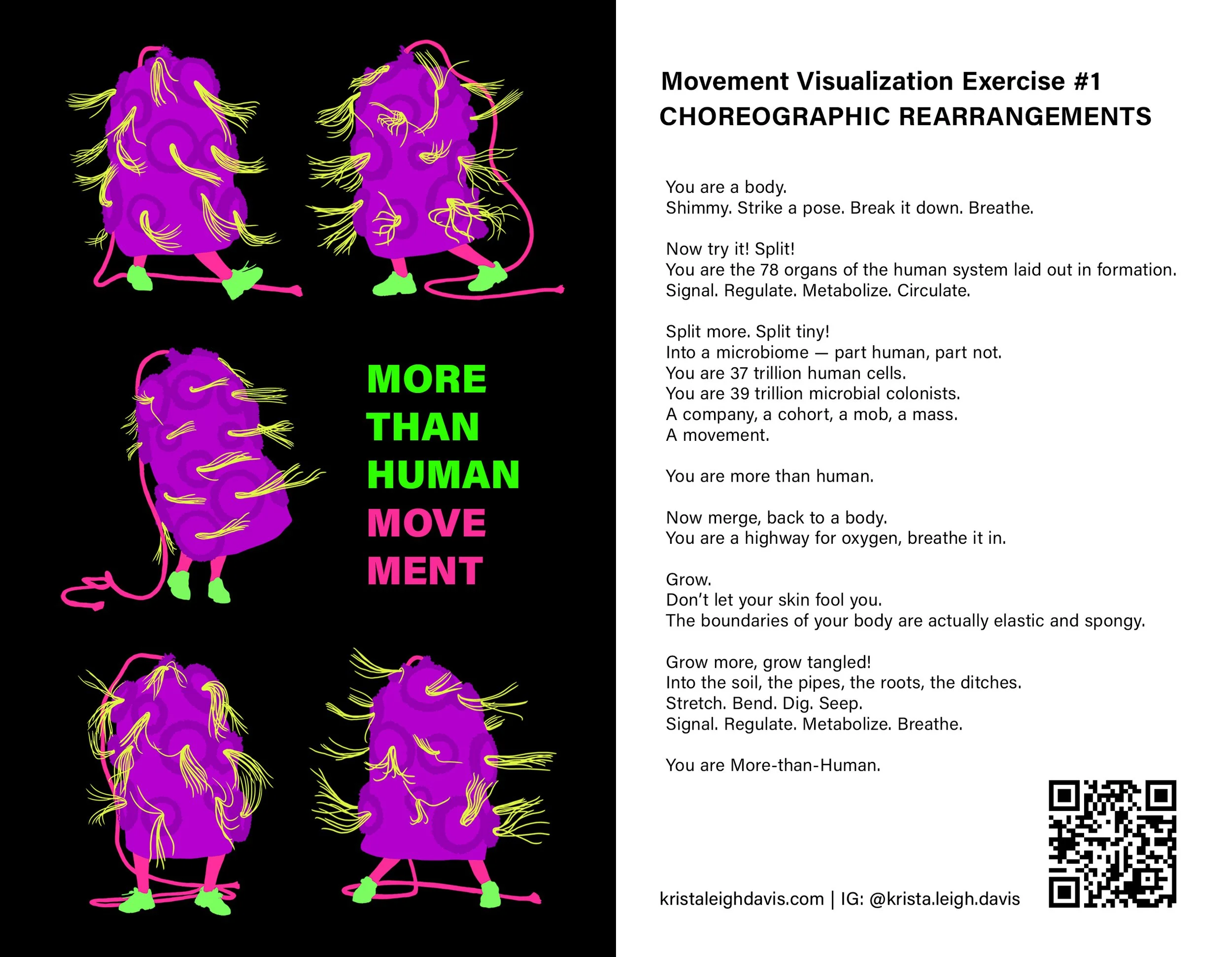

This visualization exercise was created as “microbial propaganda” for the More-than-
Human Revolution. It has been handed out at various live performances including the ArtsNS awards gala and Antigonight 2025. The writing challenges our understanding of our bodies as singular selves, breaking it down into microbial and human cells, before building it back up again out into the earth from which get our nutrients.
3. TRANSMISSION NOTICES (NO CLAIM TO THE BLUE-GREEN BLOOM)(2023)
Transmission Notices are a series of four short interludes within No Claim to the Blue-Green Bloom, a 22 minute experimental video that tells the story of a tiny revolution of care for the earth. Creatures—real and imagined, human and more-than-human—share stories on a speculative radio show transmitting from under a toxic bloom. Each story, visualized by the host through costumed performances in the landscape, proposes a strategy for reorienting our relationships to resource extraction and the messes left behind.
The Transmission Notices are placed throughout the video, punctuating longer vignettes. They offer breathing room while extending the work’s speculative ecology. Their brevity and recurrence create the rhythm of transmissions—signals surfacing from what are often considered marginal scales and minor beings. The texts link queer and ecological concerns: rejecting heroic individualism, recognizing states like disgust and overwhelm as forces to work with not surrendered to, and imagining an Anthology of Care that serializes collective stories.
By collapsing registers of scale and attention—microscopic organisms, pop-cultural pedagogy, revolutionary dispatches—the Transmission Notices fold overlooked materialities into political imagination. They are a reminder that care and resistance often emerge from the small, the unexpected, and the easily passed over.
4. PART 4: THE TRAUMA SURROGATES (NO CLAIM TO THE BLUE-GREEN BLOOM) (2023)
In Part 4 of No Claim to the Blue Green Bloom, The Trauma Surrogates looks to fungi as models for metabolizing toxicity. Informed by the bioremediating capacities of mushrooms, this work imagines a service group trained to translocate the trauma of others to their own interiors, where it can be worn out and rendered inert.
The armature for the suspended mushroom was built with wire wrapped in paper and cotton gauze, then painted with tempera and finished with gelatine.
5. DEAR FATHER (2026)
Poetry by Samanda Ritch
Animation by Krista Davis, with Samanda Ritch
This animation is from a collaboration with Samanda Ritch, a young woman serving a life sentence at the Nova Institution for Women. Since 2021, we have been working together on a series of animations for poems that tell the story of her life before incarceration.
Parentified as a child, the poem Dear Father is a personal reckoning with her understanding of her father, a single parent who struggled with addiction. Very few photos of her childhood exist, and she only has one of her father, so we decided to approach this animation by drawing the images we had over and over again.